Skate Space
- 4.5
- Rating
- 10.00M
- Installs
- Free
- Price
 Analysis by App-foxy
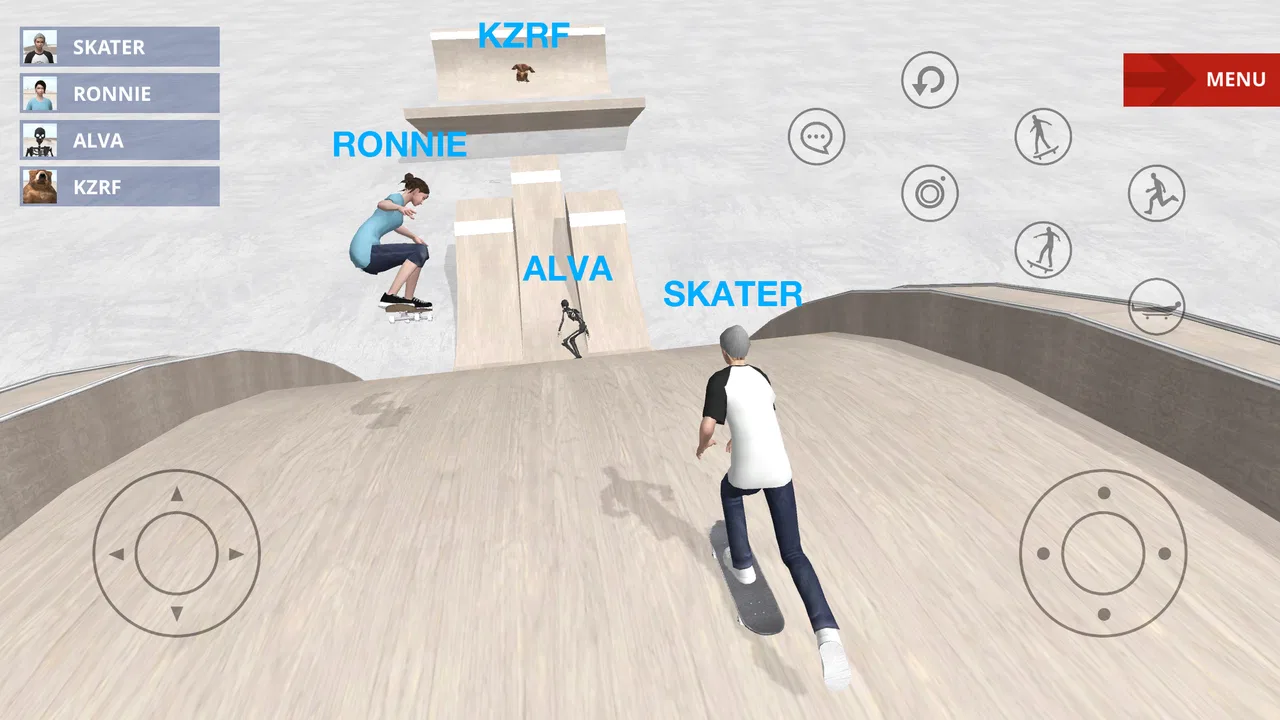
I spent my time with Skate Space looking at one feature above everything else: its multiplayer online session. That focus makes sense because this is not simply a digital skatepark where I try to beat my own score. The game is built around sharing space with other players, moving through custom parks, and treating skateboarding as something social and open-ended. When it works for the way I want to play, it feels more like dropping into a virtual meeting place than starting a traditional sports challenge.
That distinction is important before you install it. I would recommend Skate Space to someone who enjoys experimenting, watching other players, and spending a few relaxed minutes practicing movement rather than chasing a tightly scripted campaign. I would be less likely to suggest it to someone who wants a deep career mode, a carefully guided tutorial, or a realistic simulation of professional skateboarding. Its strongest idea is the shared session, and nearly every good or frustrating part of the experience comes from that choice.
Why the shared skatepark is the real game
The basic appeal is easy to understand. Instead of treating every run as a private attempt, the game puts the emphasis on skating in spaces that can be visited by other people. The presence of custom parks gives that multiplayer setting somewhere to go. A standard arena can become familiar quickly, but a collection of player-focused environments gives me a reason to keep looking around and trying different lines.
You May Also Like

 Google Keep - Notes and lists
Google Keep’s Quiet Growth Shows the Appeal of Simpler Notes
As mobile work gets busier, Google Keep keeps winning a simple contest: capture a thought quickly, find it later, and get on with the day.

 Blood Strike: 2.5 Anniversary
Blood Strike’s Loadouts Turn Every Drop Into a Tactical Gamble
A close look at Blood Strike’s custom loadouts: how fast access to signature weapons reshapes its battle royale rhythm, rewards preparation, and narrows the gap between fights.

 Pandora - Music & Podcasts
Pandora’s Music Is Easy to Start, but Harder to Recover
Pandora’s strength is its low-effort path from a seed to a station. Its weak spot is how much confidence it asks you to place in connection, setup, and quiet recovery.

 8 Ball Pool
 Is Built on Rivalries, Rematches, and Routine
A close look at the rivalries, rematches, shared routines, and unanswered safety questions that turn a quick pool match into a persistent mobile community.

 Samsung Music
’s Quiet Strength Is Playing What You Already Own
Its reach comes less from spectacle than from dependable access to a personal library. That simplicity is both the app’s strongest retention engine and its ceiling.

 AccuWeather: Weather Radar
AccuWeather Review: A Quick, Clear Forecast for Everyday Decisions
For everyday plans, the best forecast is the one you can understand quickly. AccuWeather makes rain timing, radar, and local conditions easy to act on, with a few trade-offs.
More From Our News Desk



In practice, this changes the rhythm. I am not only asking whether I can land a trick. I am also considering where to begin, which ramp or rail might connect to the next section, and whether another player’s route reveals something I had overlooked. A custom park can encourage careful exploration in one session and quick improvisation in another. That variety is more valuable here than a long list of conventional sports modes would be.
There is also a useful social layer even when I am not actively communicating with anyone. Seeing other skaters occupy the same environment gives the park a sense of activity. Their movement can make a location feel like a place rather than a menu of challenges. For me, that is the capability’s real effect: it turns practice into a shared spectacle. I can work on my own timing while still feeling connected to the wider session.
The developer, DRSV, LLC., has positioned the game as a free sports title, and that makes the multiplayer concept easy to sample. I do not have to commit to a paid purchase before discovering whether this type of skating suits me. The game is rated for Everyone, so it is also approachable for households looking for a casual sports game rather than an intense or mature experience. That does not mean every player will enjoy it equally, but the entry point is uncomplicated.
What an online session feels like in everyday play
My favorite way to approach Skate Space is in short, unplanned visits. I might have a few minutes while waiting for an appointment, open the game, choose a park, and spend the first moments simply observing its layout. If the environment has a good flow, I start linking familiar movements together. If another skater is nearby, I may follow their line briefly, then try to adapt it instead of copying it exactly.
This is where the game differs from a conventional trick-focused sports title. In a more structured alternative, I would usually receive a clear objective: complete a challenge, earn a score, unlock a location, or finish a timed run. Here, the motivation is more self-directed. I decide whether the session is about learning one difficult section, finding a better route, or just enjoying the atmosphere of a busy park.
That freedom is a strength, but it also asks more from me. Without a strong personal goal, a session can feel loose. Players who need constant progression may wonder what they are supposed to do next. I found that the best solution was to create small goals rather than wait for the game to provide them. For example, I would choose one obstacle and keep returning to it until my approach felt consistent, then move to a different part of the park.
A useful tip is to treat each custom park as a route-planning exercise instead of immediately trying the most impressive-looking obstacle. I first look for simple connections between surfaces, ramps, and open areas. That gives me a reliable starting line and helps me understand the park’s shape. Only after that do I attempt more ambitious movement. This approach reduces wasted attempts and makes unfamiliar parks feel less chaotic.
Another practical habit is to watch the session before judging it. A park may look ordinary when I first enter, yet another player’s path can show how its pieces are intended to connect. I have found that the multiplayer capability is not only about competition or showing off. It can act as an informal demonstration system, where other skaters provide visual clues about routes I would not discover as quickly on my own.
The best scenario: a relaxed session with friends or strangers
The game makes the most sense for someone who wants a casual social activity rather than a serious competitive ladder. Imagine finishing work or school and wanting something more active than scrolling through videos, but not wanting to begin a long campaign. I would open Skate Space, spend a few minutes getting comfortable in a park, and then use the shared environment as a low-pressure place to practice. There is no need to prepare a team or reserve a large block of time.
It can also suit friends who enjoy comparing routes informally. One person might discover a clean line through a park, while another tries to improve it or find a more difficult variation. The important point is that the game’s social value does not depend entirely on formal competition. The park itself becomes the conversation starter. That is a better fit for players who enjoy showing technique and exploring than for people who only care about a scoreboard.
For younger players, the Everyone rating makes the game easier to consider as a family-friendly option. I would still encourage an adult to try the controls first, because an age rating does not tell me whether the handling will feel immediately comfortable on every device. The game’s appeal depends on how quickly a player can understand movement and enjoy experimenting, so a short hands-on test is more useful than relying on the label alone.
It is also a reasonable choice for someone moving between devices that still meet its software requirement. Skate Space supports Android 7.0 and later, which covers a broad range of Android phones and tablets. That does not guarantee identical performance on every model, and I would not assume that an older device will deliver the same smooth experience as a newer one. Still, the compatibility threshold is not unusually demanding for an Android sports game.
On iOS or Android, I would approach the game with the same expectation: this is a place to play, not a replacement for a full console skateboarding package. A console alternative may offer more elaborate presentation, deeper career progression, and more carefully authored levels. Skate Space answers a different question. It asks whether a portable, multiplayer park can keep me interested through exploration and shared activity.
Where the freedom becomes a limitation
The biggest trade-off is the lack of a strong structure in the experience I wanted. Open-ended skating can be refreshing, but it can also make the game feel less rewarding after the novelty of a new park fades. If I am not in the mood to invent a challenge for myself, I may finish a session without feeling that I accomplished anything. That is not necessarily a design flaw, but it is a clear mismatch for players who prefer guided progression.
The multiplayer emphasis creates another dependency: the quality of the session is influenced by the people sharing it. A lively park can make the game feel welcoming, while a quiet or distracting session may reduce the sense of connection. Because the central capability relies on a shared environment, the experience is naturally less predictable than a completely offline skateboarding game.
Custom parks are valuable because they expand the places I can explore, but variety alone does not guarantee that every location will be equally enjoyable. Some layouts may suit smooth lines, while others may feel awkward until I understand their intended route. I try not to judge a park after one failed attempt. I give it time to reveal its flow, but I also accept that not every design will match my preferred style.
There is a learning curve in the controls as well. Skateboarding games often look simple from the outside because the goal is visually clear, yet timing and positioning can make a basic maneuver feel inconsistent at first. I recommend practicing in a less crowded area before trying to perform in front of others. That small adjustment makes the multiplayer space feel less intimidating and helps me separate control mistakes from problems caused by a particular park.
The free entry is welcome, but optional purchases range from $0.99 to $19.99 per item. I would start without spending anything and decide whether the core session loop has earned more of my attention. The sensible trade-off is to treat purchases as optional personalization or convenience rather than as a reason to install the game. If I already enjoy the shared parks, spending may feel more reasonable; if the multiplayer format does not hold my interest, no purchase will solve that fundamental mismatch.
Skate Space has an average rating of 4.5 from around 30 thousand ratings, with roughly 2 thousand written reviews. Those figures suggest that many players connect with its central idea, but they should not replace a personal test. A strong average cannot tell me whether I prefer open-ended sessions or structured objectives. I see the rating as a reason to investigate, not as proof that the game will suit every skating fan.
Small techniques that make the central feature better
My first concrete recommendation is to enter a park with a single question in mind. Instead of trying every obstacle, I ask whether I can create one repeatable line from the entrance to a recognizable landmark. This gives the session direction and makes improvement visible. Once that line feels natural, I add one change, such as a different approach or a harder transition. The method works especially well when the custom layout initially feels confusing.
Second, I use other skaters as moving reference points. I pay attention to where they slow down, where they turn, and which sections they avoid. That does not tell me that their route is objectively best, but it offers information about the park’s practical rhythm. A route that looks exciting may be difficult to repeat, while a less dramatic line may be better for practicing consistency.
Third, I separate exploration from performance. On the first visit to a new park, I do not try to impress anyone. I learn its edges, open spaces, and likely restart points. On the next visit, I focus on execution. This two-stage workflow is more efficient than repeatedly attempting tricks without understanding the environment. It also makes the multiplayer setting less stressful because I am not confusing discovery with failure.
Finally, I recommend setting a natural stopping point. Because the game is open-ended, it is easy to repeat the same attempt long after the session has stopped being enjoyable. I might decide to leave after finding one satisfying line or after making a certain section feel reliable. That keeps the game suitable for short breaks and prevents the lack of formal objectives from turning into aimless repetition.
Who benefits most from the multiplayer design
The best audience is a player who enjoys virtual skateparks as social spaces. You will probably get the most from Skate Space if you like learning through observation, trying unusual routes, and returning to a location to improve gradually. It is also a good fit if you want a free sports game that can be opened for a short session without requiring a long narrative commitment.
I would be more cautious about recommending it to someone who wants a realistic training tool for physical skateboarding. A game can help with imagination and route planning, but it cannot reproduce the balance, impact, and physical judgment of standing on a real board. Likewise, players who want a detailed career, licensed competition atmosphere, or a carefully paced single-player campaign may find a traditional skateboarding game more satisfying.
The game is currently at version 1.489, and its popularity is reflected in more than ten million installs. That level of reach makes the multiplayer concept easier to understand: this is not a niche experiment that only works when a small group of enthusiasts is present. Even so, popularity does not remove the central trade-off. The game remains strongest when I actively enjoy sharing space and creating my own goals.
For me, the final decision comes down to what I want from a sports game. If I want a clear sequence of missions, I would choose another option. If I want a portable skating playground where custom environments and online sessions shape the experience, Skate Space is a compelling free download. I appreciate that I can try the main idea without paying upfront, and I like that the game rewards curiosity more than strict completion.
My recommendation is simple: install it if the idea of skating alongside other players sounds more appealing than following a fixed campaign. Give the first session enough time to explore one park, observe how others move, and build a small route of your own. If that process feels satisfying, the game has found its audience in you. If you need constant goals or a highly realistic simulation, it is better to skip it and choose a more structured alternative.
FAQs for Skate Space
01What is Skate Space and how does it work?
Skate Space is an immersive skateboarding game designed for Android and iOS platforms. It allows players to explore a vast skatepark, perform tricks, and compete with friends. The game features customizable avatars and boards, providing a personalized experience. Players can refine their skills, participate in challenges, and enjoy an engaging skating environment.
02Is Skate Space free to play or does it require in-app purchases?
Skate Space is free to download and play, offering a variety of features at no cost. However, it includes optional in-app purchases that allow players to unlock special items, additional customizations, and premium features. These purchases enhance the gameplay experience but are not necessary to enjoy the core game.
03What are the system requirements for Skate Space?
To run Skate Space smoothly, ensure your device meets the minimum system requirements. For Android, a device with version 5.0 or higher is recommended, while iOS devices should run at least iOS 10.0. Adequate storage and a stable internet connection are also advised for optimal performance and updates.
04Can I play Skate Space offline?
Skate Space offers limited offline functionality. While you can practice tricks and explore the skatepark without an internet connection, certain features like online multiplayer, leaderboards, and event participation require connectivity. To fully enjoy all aspects of the game, an internet connection is recommended.
05How can I customize my skateboard and character in Skate Space?
Customization is a key feature of Skate Space. Players can personalize their skateboard and character by accessing the customization menu. Options include changing the board’s design, wheels, and trucks, as well as altering the character's appearance with different outfits and accessories. Customization items can be unlocked through gameplay or in-app purchases.
Pros
- Realistic skateboarding physics.
- Customizable skate parks and avatars.
- Multiplayer mode for global competition.
- Variety of tricks and combos.
- User-friendly interface and controls.
Cons
- In-app purchases can be pricey.
- Occasional lag in multiplayer mode.
- Limited offline features.
- Graphics could be more detailed.
- Ads can interrupt gameplay.

Skate Space
Gallery